|
|
|

Back to basics
Part 1 - Components of a Steam Locomotive
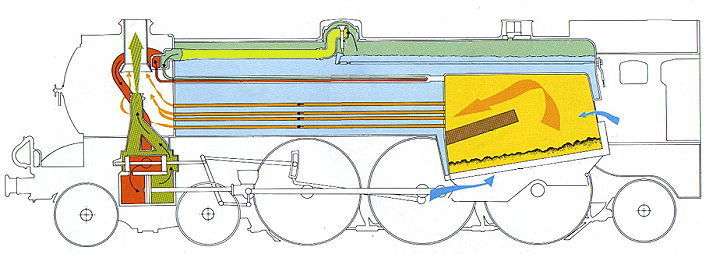
Position the mouse cursor over part of the image below to find its name and function
The workings of a steam locomotive are fairly well known, a sort of boiler on wheels most would say. However, not many know of the exact science that goes into designing such an engine. This section on the basics of a steam locomotive takes you from the names and functions of each component, the features of their design, and ending with the importance of the mineral composition of a lump of coal or the water in the tender. Copyright © by John Daniel 2013.
Smokebox door - Gives access to the smokebox for the removal of char
Chimney - Removes the smoke and cooled steam away from the boiler
Steam feed pipe - transfers the steam from the superheater header to the valves
Blastpipe - removes the cooled steam away from the cylinder and smoke from the firebox
Valves - admits and exhausts the steam from the cylinder as timed by the valve gear
Cylinder and piston - where the superheated steam is converted into mechanical energy
Valve gear - linkage that times the intake and extraction of steam from the cylinder
Bogie wheel - carried in the bogie frame that is usually mounted to the locomotive frame by a swivel
Front frame and buffers
Superheater header - where steam to and from the superheater tubes is divided
Main steam pipe - transfers steam from the regulator valve to the superheater header
Steam dome - highest point of the boiler and also usually contains the regulator valve
Regulator rod and handle - basically the accelerator of the locomotive
Safety valves - release steam when the maximum boiler pressure is exceeded
Saturated steam area inside the boiler
Superheater tubes - where the saturated steam at 200°C is superheated to 350°C
Fire tubes - carry the heat of the firebox into the boiler and so raising the temperature of the water
Firebox - burns fuel to produce heat
Brick arch - encourages combustion of gas distilled from the firebed and lengthens the path of those gases to give more time for combustion
Ashpan and damper doors - controls the amount of primary air below the grate that is drawn through the firebed
Driving wheels - connected to each other by connecting rods, this engine has six - and with four bogie and two trailing wheels gives the engine a configuration of 4-6-2
Trailing wheel - supports the weight of the rear of the locomotive
Driving cab
Beginning with the heart of a steam locomotive - its boiler - it is the most compact of all types of boiler in relation to the amount of steam that it produces. Suitable for pressures up to about 300 pounds per square inch, it is usually fired by coal although oil has also been widely used. In some countries, the fuel can also be wood, sugar cane waste or even peat.
The fuel is burned on the grate of the inner firebox. This firebox is surrounded by water in the outer firebox shell and so absorbing radiant heat from the fire. The gap between the inner and outer fireboxes is maintained by hundreds of rigid stays.
To support combustion, air is admitted into two areas:
1, Primary air enters via damper doors in the ashpan and is drawn through the firebed. This makes the fuel incandescent but it is not sufficient to burn all of the elements of the coal.
2, Secondary air is drawn through the firehole door or small flaps.
The brick arch within the inner firebox is constructed of firebrick or refractory concrete and serves three purposes. As its material is incandescent, it encourages combustion of gas distilled from the firebed; it lengthens the path of those gases to give additional time for combustion and it prevents cool air reaching the fire tubes as it enters the firehole door.
The hot gases are drawn through long tubes surrounded by water in the boiler barrel, to the smokebox at the front of the engine. On later locomotive boilers, these tubes are of two types, small ones of about 1¾ - 2¼ inches in diameter and large flues of 5 - 5½ inches diameter.
The saturated steam that is generated collects above the water in the boiler. Its journey to the cylinders is controlled by the regulator valve operated from within the cab by the regulator handle. It travels through the main steam pipe to the superheater header, which is divided into two separate areas. The saturated steam at a temperature of about 200ºC passes through the superheater elements and increasing its temperature to about 350ºC. Returning to the other side of the superheater header, the superheated steam flows via steam pipes to the valves and then on to the cylinders.
The gases from the fire, now much cooler after giving up much of their heat to the water and steam, are ejected through the chimney. This is greatly assisted by the exhaust steam from the cylinders passing through the reduced orifice of the blastpipe at high speed, and capturing the gases on the way. By this method the smokebox maintains a partial vacuum that provides a draw on the fire.
Replacement water is forced into the boiler by injectors or pumps, maintaining a safe level above the inner firebox crown. Safety valves on top of the boiler release steam when the pressure within the boiler rises above a predetermined level.