
|
|
|

2900 'Saint' class introduction
Running numbers 4900 to 7929.
Built 1902 (2900) to lot number 132,
1903 (2998) to lot number 138,
1903 (2971) to lot number 145,
1905 (2972 - 2980) to lot number 154,
1903 (2981 - 2990) to lot number 158,
1906 (2901 - 2910) to lot number 164,
1907 (2911 - 2930) to lot number 170,
1911 (2931 - 2940) to lot number 185,
1912 (2941 - 2950) to lot number 189,
1913 (2951 - 2955) to lot number 192.
T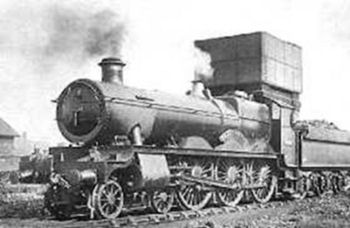 hree prototype versions of what was to become the 'Saint' class of locomotives were made in 1902/3. The first of these was number 100 and it was completely different to what the Great Western had produced before. Built to his ideas on standardisation of design, G. J. Churchward created a large response for its completely modern look, but few people realised the great developments that it would bring about.
It was originally built with a parallel boiler, then with a half-cone boiler in 1903 and later the first superheated half-cone boiler in 1910. The locomotive was said to have an American look about her and it was true that Churchward had investigated American designs on boilers, but for efficiency in the design of the motion, it was to the continent that he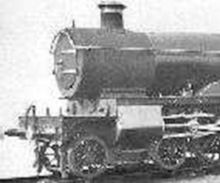 turned. To this end, a locomotive was ordered from the Société Alsacienne for the De Glehn 4-4-2 compound engine so that Churchward could compare the design with his own.
The second prototype was engine number 98. Built with a half-cone boiler as standard, the difference between the earlier locomotive was in the valve gear layout and cylinder design, and in addition, the valve diameter had grown from 6½ inches to 10 inches.
The third and last prototype was number 171 and although built in 4-6-0 configuration, it was quickly converted to 4-4-2 so that a direct comparison with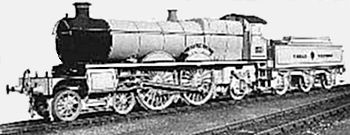 the De Glehn locomotives was established. The third prototype's main contrast with previous prototype engines was a working pressure of 225 lbs.
While the trials between the two locomotives were taking place, a further nineteen locomotives were ordered similar to the design of 171 except that thirteen were built as 4-4-2's while the remaining six were built as 4-6-0s, until a decision was made on the best wheel arrangement for the Great Western's lines.
Detailed Modifications.
The second batch, were the 'Saints' with numbers 2911 to 2930. These had the curved frames at the front and rear of the locomotive, and soon afterwards the initial batch of ten 'Ladies' together with most of the prototypes, numbers 2971 to 2998, except for numbers 2900 / 1 / 4 / 7 / 9 / 10 / 71 / 73 / 74 / 75 / 76 / 77 / 78 and 98.
Preservation.
All examples of the 'Saint' class were scrapped at Swindon by 1954, but plans are being made by one of the preservation sites to convert a 'Hall' class locomotive into a 'Saint' class engine.
Specifications.
| No. 100, 'William Dean' | Saint class | |||
| Cylinders | (2) 18 x 30 inches | (2) 18½ x 30 inches | ||
| Driving wheel diameter | 6 feet 8½ inches | 6 feet 8½ inches | ||
| Bogie wheel diameter | 3 feet 2 inches | 3 feet 2 inches | ||
| Tractive Effort | 20,530 pounds | 24,395 pounds | ||
| Boiler type | Parallel | Number 1 | ||
| Boiler maximum dia. | 5 feet 0 inches | 5 feet 6 inches | ||
| Boiler minimum dia. | 4 feet 10 ¾ inches | 4 feet 10 13/16 inches | ||
| Fire tubes, no. and dia. | 287 x 2 inches | 176 x 2 inches | ||
| Flue tubes, no. and dia. | None | 14 x 5 1/8 inches | ||
| Superheater tubes, no. and dia. | None | 84 x 1 inch | ||
| Boiler pressure | 200 lbs/square inch. | 225 lbs/square inch. | ||
| Boiler length | 14 feet 8 inches | 15 feet 2 7/16 inches | ||
| Area of firegrate | 27.62 square feet | 27.07 square feet | ||
| Heating surfaces, tubes | 2,252.94 square feet | 1,686.6 square feet | ||
| Heating surfaces, firebox | 157.94 square feet | 154.78 square feet | ||
| Heating surfaces, superheater | None | 262.62 square feet |
Copyright © by John Daniel 2013.